DILEMMIX is an online dilemma and social prediction game for friends, couples and groups. Every round gives everyone the same A/B choice. First you decide what you would choose. Then, before the answers are revealed, you predict what the other players chose. That means every round asks two different questions: what would you choose, and how well do you know the people around you?
DILEMMIX in 30 seconds
The core loop is deliberately simple. You do not need a long rules explanation before the first round.
- Choose — answer the A/B dilemma for yourself.
- Predict — guess what the other players chose before you see their answers.
- Reveal — see everyone’s choices and which predictions were correct.
- Discuss — find out why somebody chose the answer you never expected.
The choice is only half the game
Most A/B conversation games focus on one question: what would you choose? DILEMMIX keeps that question, then adds another one before the reveal: what do you think they chose?
That small change turns a preference into a social prediction. You might know that one friend hates uncertainty, that another usually chooses experiences over money, or that your partner has argued for the same value a dozen times. Then a new dilemma appears and all of those assumptions have to survive one actual choice.
Sometimes they do. Sometimes the friend you were certain about picks the opposite option. That gap between expectation and reality is often where the most interesting conversation starts.
How a DILEMMIX round works
The steps below describe a multiplayer round. Solo keeps the A/B choice and comparison with global statistics, without predicting another participant. With two players, predict the other person's choice; with three or more, predict the group's majority.
- Choose for yourself. Everyone receives the same dilemma and commits to an answer without seeing the group.
- Read the people around you. Use what you know — or think you know — to predict their choices.
- Reveal the answers. The group sees who agreed, who surprised everyone and which predictions were correct.
- Ask why. The vote tells you what someone chose; the explanation tells you why.
How is DILEMMIX different from Would You Rather?
Would You Rather and DILEMMIX share a useful starting point: one question, two alternatives and a choice that is easy to understand. The difference is what the game does with that choice.
Classic Would You Rather usually ends with the answer and discussion. DILEMMIX inserts a prediction stage before the reveal, lets players score accurate reads of the group and can compare choices with global statistics.
So the simplest distinction is this: Would You Rather asks what you would choose. DILEMMIX asks what you would choose and what you believe the people around you will choose.
| Would You Rather | DILEMMIX | |
|---|---|---|
| Choose between two options | Yes | Yes |
| Explain your choice | Often | Yes |
| Predict another player’s answer | Not usually | Core mechanic |
| Reveal everyone’s choices together | Depends on how you play | Core mechanic |
| Score accurate social predictions | No standard scoring | Yes |
| Compare with global responses | Depends on the version | Available |
Is DILEMMIX a “How well do you know your friends?” game?
Partly, but not in the trivia-quiz sense. DILEMMIX does not ask whether you remember someone’s birthday, favorite film or a fact they told you years ago.
Everyone answers the same hypothetical choice. Your challenge is to predict how another person will respond now. That makes the game less about remembering facts and more about the picture you have built of someone’s preferences, priorities and values.
A friend you have known for ten years can still surprise you. Someone you met recently can sometimes be unexpectedly easy to read.
This is not a prediction game about the future
Many prediction games ask you to predict what will happen next: a result, an event or a future outcome. DILEMMIX asks you to predict something much closer to home — the choice another person is making in the same dilemma you just answered.
You are not trying to forecast tomorrow. You are testing the mental model you have built of someone else. That is why the same dilemma can feel completely different with close friends, a partner, coworkers or people you have just met.
Why predicting friends can be harder than it looks
Knowing somebody well does not make every new preference perfectly predictable. We fill missing information with memories, assumptions and sometimes our own answer.
Research by Tal Eyal, Mary Steffel and Nicholas Epley found across 25 experiments that simply trying to imagine another person’s perspective did not consistently increase interpersonal accuracy. In their final experiment, directly getting the other person’s perspective through conversation did improve accuracy.
DILEMMIX was not part of that research, and a game result is not a psychological measurement. The useful connection is smaller: making an assumption about somebody and then hearing their actual reasoning are two different sources of information. That is why the explanation after the reveal can matter more than the point.
What kinds of dilemmas can you play?
DILEMMIX is not built around one mood. The public experience moves between icebreakers, moral dilemmas, relationships, psychology, friendship and harder impossible choices, so the group can choose the kind of conversation it wants to have.
A lighter category can work when people are still warming up. A more difficult one can put loyalty, honesty, freedom, security or relationships into direct conflict once the group is comfortable disagreeing.
Full DILEMMIX packs contain 50 dilemmas. The Journal only previews a small number of real questions so the choices and reveals inside the game still have room to surprise you.
Who can play DILEMMIX?
The mechanic stays the same, but the experience changes with the people in the room.
- Close friends — when confidence makes every wrong prediction funnier.
- New groups — start with lighter dilemmas that give everyone something concrete to react to.
- Couples — compare your own answer with what you assumed your partner would choose, without treating the result as a compatibility test.
- Parties and game nights — the rules are quick to understand, so the complexity comes from the people rather than a rulebook.
- Long-distance friends — the browser-based game can be combined with a voice or video call.
How to start in each game mode
Use the mode selector on the home screen, then press Play now. The game runs in a browser/PWA. Here is what to prepare for each of the three modes.
Solo — explore your own choices
Choose Solo and an active, unlocked pack.
Read the dilemma and select A or B for yourself.
See the distribution of answers in global statistics.
Continue to the next dilemma or pause on a question that surprised you.
Solo does not ask you to predict another participant. You can start without registering; an account lets you keep progress across devices.
Pass & Play — together in the same room
Choose Board Game, then Digital mode to enter answers on one phone.
Select a pack and add the participants' names.
Read the dilemma together, then pass the phone to the named person without showing answers.
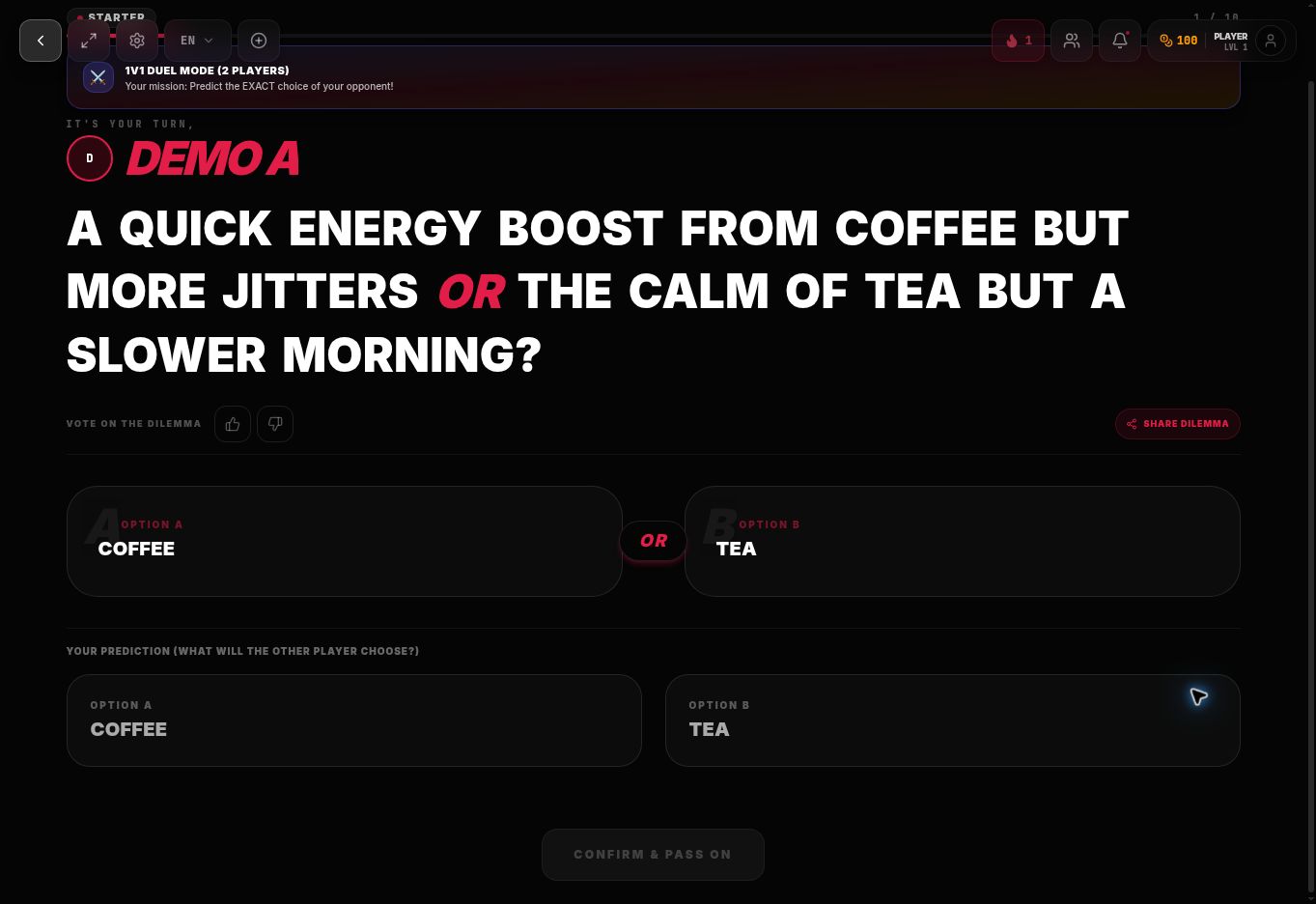
Each person enters a choice and a separate prediction. Confirm before passing the phone.
After the final vote, the game reveals the answers and calculates points.
In Physical mode, the phone is the central display and participants write their choices and predictions on paper. The host marks points after the reveal. Solo and local play both work without registration.
Party Online — everyone on their own device
The host chooses Online, enters a name and signs in to an account to create a room.
Share the PIN with friends. Guests join with their name and the PIN on their own device.
The host selects an available pack and starts once everyone is ready.
Everyone submits a choice and a prediction; after all votes, the game shows the result and calculates scores.
In the normal joining flow, guests do not need to create an account. If joining fails, check the PIN and whether the host still has the room open.
Prediction rule: with exactly two players, the target is the other person's answer. With three or more, it is the majority of the group's A/B answers. A correct prediction earns +1; an A/B tie in a group gives nobody a prediction point.
Choice, prediction, result: the game screens
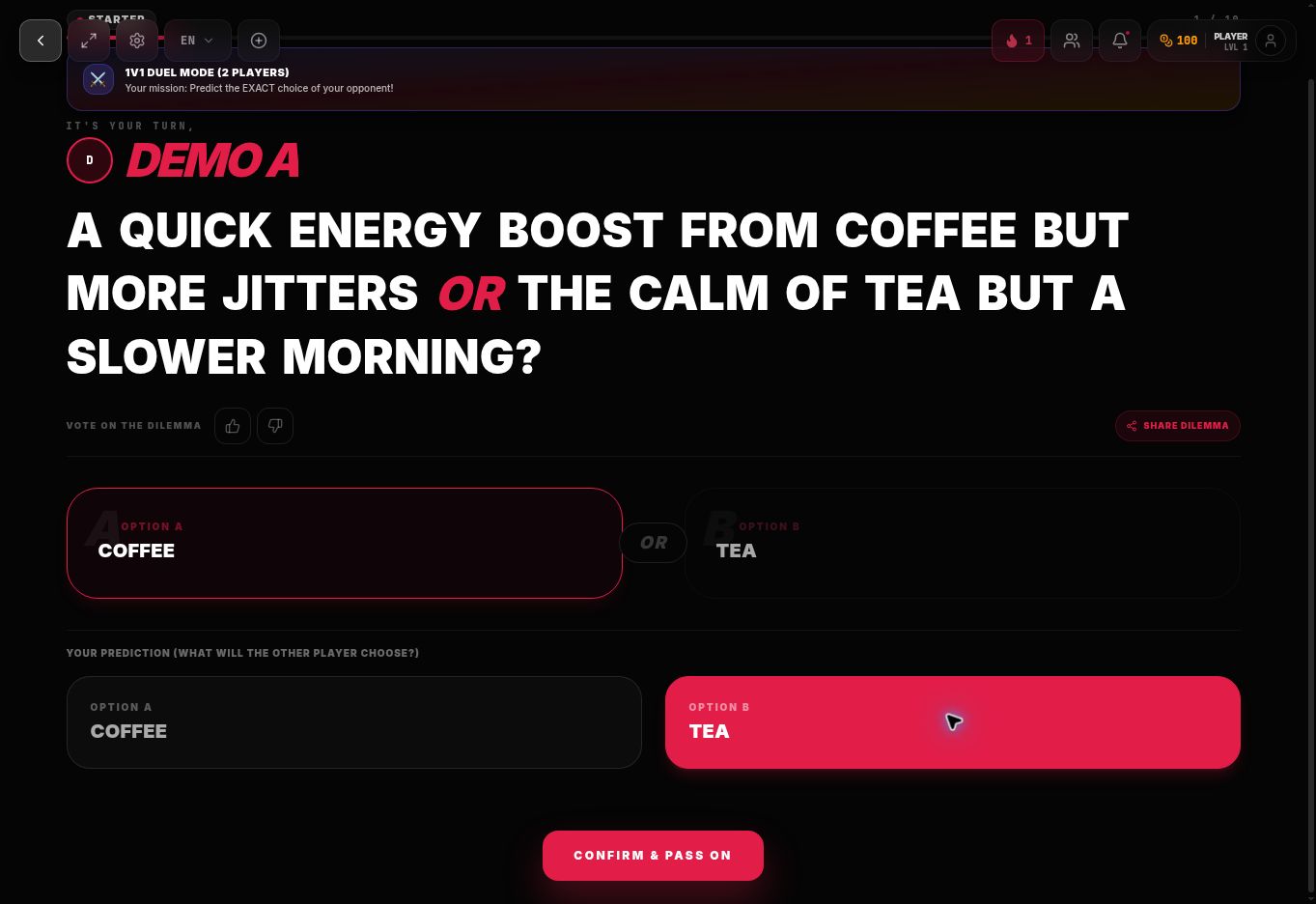
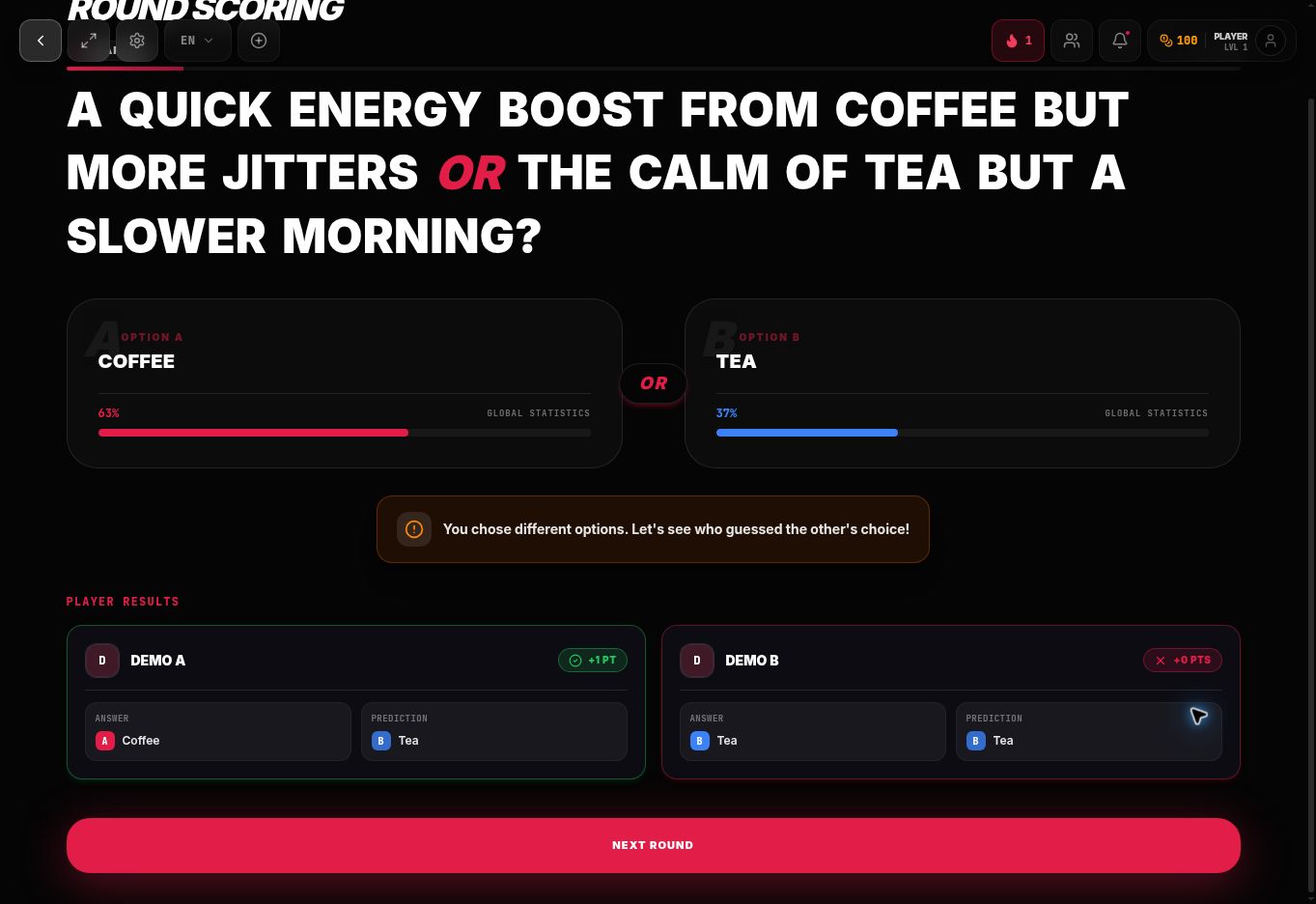
Captured from the public web game on 2 October 2026 with the English interface, shared across all language versions of this guide. Demo A and Demo B are fictitious participants configured for this guide. Click an image to open its original size.
One round explained: a vote is not a prediction
In the captured round, A is Coffee and B is Tea. Here is exactly what we entered for the two fictitious participants.
| Participant | Own choice | Prediction about the other | Points |
|---|---|---|---|
| Demo A | A — Coffee | B — Tea | +1 |
| Demo B | B — Tea | B — Tea | +0 |
Demo A earns the point because Demo B really chose B. Demo A's own choice of A does not affect that correct prediction.
Demo B earns no point: the prediction was B for Demo A, who chose A. Predicting your own answer or agreeing with the other person is not the aim of the duel.
With three or more participants, predictions are compared with the group's majority rather than one chosen person. Global statistics remain a separate comparison.
After the reveal, ask: Would an important morning meeting change your answer? Would you make the same choice on a weekend? Discuss the context behind each choice without turning one answer into a personality label.
What DILEMMIX is not
A DILEMMIX answer is not a diagnosis, moral score, personality profile or relationship verdict. It is one response to one hypothetical situation.
Mood, wording, recent experiences and the details a player imagines can all change the answer. The game works better when choices are treated as openings rather than labels.
Instead of saying, “Your answer proves you are selfish,” the more useful question is, “What made that option worth choosing for you?”
What makes a good DILEMMIX dilemma?
A strong dilemma does not need to be shocking. It needs genuine tension between the options. If one side is obviously wonderful and the other obviously terrible, there is very little to discover.
The better questions make you give something up whichever side you choose: comfort or adventure, truth or protection, freedom or security, loyalty or fairness, certainty or possibility.
The wording matters too. The two options should be comparable in tone and perceived cost so that the choice measures a real trade-off rather than which answer was written to sound more admirable.
How we build and review a DILEMMIX pack
A DILEMMIX pack is not assembled by dropping a long list of prompts into a template. Our working editorial checklist looks for balanced A/B trade-offs, repeated ideas, tone, category fit and whether both options are plausible enough to divide a real group.
The same check matters during localization. A literal translation can preserve the words and still lose the dilemma, so phrasing is adjusted when an idiom, cultural reference or difference in intensity would make one option feel artificially stronger.
Before a pack is treated as complete, we also check the intended pack size, the public sample dilemmas and cross-pack duplication so the preview represents the pack without giving away the full set.
- Balance — both choices need a believable reason to be chosen.
- Originality — repeated or near-duplicate dilemmas are flagged across packs.
- Localization — meaning and tension matter more than word-for-word translation.
- Preview integrity — public samples are checked separately from the full pack.
Editorial workshop: turn a label into a real choice
An editorial exercise created for this guide. It demonstrates a rewrite, not a claim about user testing or the history of a published pack.
First draft
Would you rather be a good friend or be selfish?
Rewritten version
You have reserved your only free evening this week for rest. A friend asks for help moving that same evening. What do you choose?
What changed and why
Remove good and selfish: those labels suggest the acceptable answer before anyone chooses.
Specify the timing and cost: there is only one free evening, and the request conflicts with the rest you planned.
Give each option a plausible priority and a loss. This does not assume that votes will split evenly.
Discuss: How tired are you? How urgent is the move? How often does this friend ask for help? Context can change the choice; one answer cannot tell you how good a friend someone is.
Frequently asked questions
What is DILEMMIX?
An online dilemma and social prediction game where players choose between two options, predict one another’s answers and reveal the results together.
Can I play with friends online?
Yes. Party Online is one of the current game modes.
Can I play alone?
Yes. Solo mode focuses on your own choices and global statistics.
Do I need to install an app?
No installation is required for the current browser/PWA version.
Is DILEMMIX a personality or relationship test?
No. Individual answers are not psychological assessments or compatibility scores.
What languages are supported?
English, Romanian, Spanish, French, Italian and German.
Do I need an account?
Solo and Pass & Play work without registering. In Party Online, the host must sign in to an account to create a room; guests can join with a name and PIN without creating an account in the normal flow. An account helps keep progress across devices.
What can I play without Premium?
You can start with Starter without Premium and other active packs unlocked for you. Check the selector labels: locked content and packs marked Coming soon cannot start that session. Availability can change.
Can I buy Premium now?
Premium checkout is not enabled yet. Plans are being prepared; showing the benefits does not mean you can complete a purchase. No Premium payment is needed to try Starter.
Do I predict one person or the majority?
With two players, predict the other person's exact choice. With three or more, predict the group's majority; an A/B tie gives nobody a prediction point. Solo compares your own choice with global statistics.
Research and further reading
- 01View source
Perspective mistaking: Accurately understanding the mind of another requires getting perspective, not taking perspective
Journal of Personality and Social Psychology, 114(4), 547–571 · 2018
Across 25 experiments, instructions to imagine another person's perspective did not consistently improve interpersonal accuracy. In the final experiment, directly getting the other person's perspective through conversation did improve accuracy.
The first choice is easy. Predicting everyone else is harder.
Choose what you would do, predict the people around you and discover which answer nobody saw coming.